Note, 29 September 2026: The R values in this study come from our older backtest chain. On a random market without direction that chain still books positive R, so the absolute levels here are too high, and comparisons within the chain are not proven either. Why, and what we changed: The random market as a ruler.
Re-run, 5 October 2026: The 25 combinations of breakout rule and market from our rulebook have been re-measured on the corrected chain and on real broker ticks. None has an advantage over the random market; after costs the mean is −0.08 R per trade. Positive R levels and comparisons in this study are therefore not proven. All numbers: Our own breakout rules, re-measured.
Data basis: 4 markets (DAX, FTSE, NQ, Dow), six of our classic intraday setups (breakout family plus one fade), M15 episode basis, 05 Jan 2015 – 05 Jun 2026, 66,511 trades on 2,949 trading days. Exit: trailing stop BE 0.5 / TS 1.0 / step 0.5, net of spread and slippage. Calendar: US CPI, US PPI, FOMC statement days, NFP (first Friday). "Book day R" = sum of R across all trades of a calendar day. No trading recommendation.
August 2026 had a clean narrative. A PPI surprise produced a trend day, an in-line CPI produced chop, and the waiting week before Jackson Hole was one long back-and-forth. A rule forms quickly from that: trend days need a catalyst, and days on which the market waits for a scheduled release are chop days.
The rule sounds plausible because it held three times in August. Three observations are not a test. We ran it across eleven years against our complete setup book.
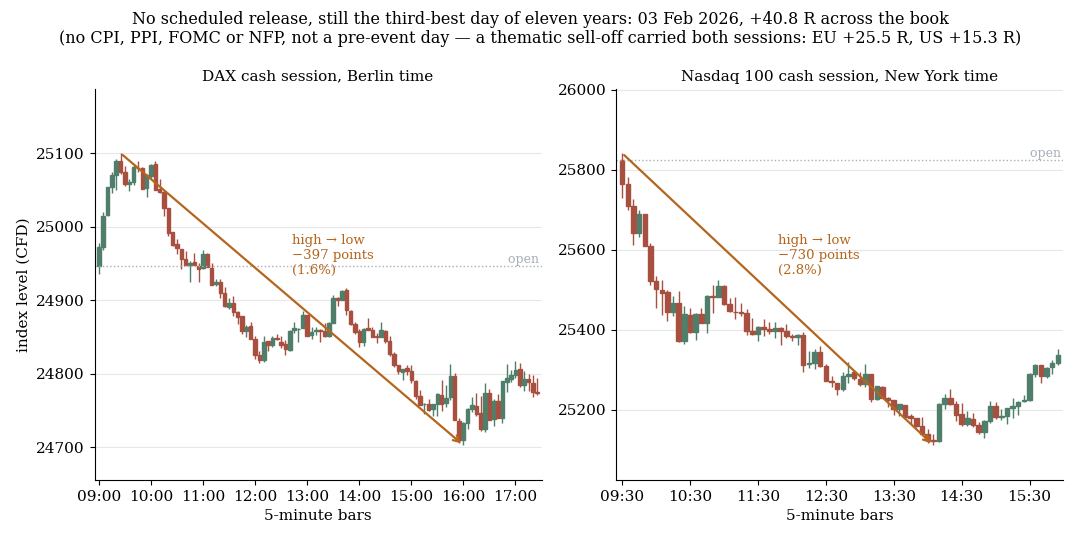
Third-best book day in eleven years, without a single scheduled release: 3 February 2026, DAX and Nasdaq on 5-minute bars, a thematic sell-off carries both sessions.
1. Where do the big days come from?
The simplest question first: if trend days needed catalysts, the best days of the book should cluster on event days.
| Group | Share with event or pre-event day |
|---|---|
| Base rate, all trading days | 29% |
| Top 50 book days | 34% |
| Bottom 50 book days | 30% |
No enrichment worth the name. Of the 15 best days in eleven years, eleven have no scheduled release. The third-best day (03 Feb 2026, +40.8 R) was a thematic rally with no release at all. The second-best (15 Jan 2015, +46.3 R) carries the label "PPI" but was the day of the SNB shock — the calendar entry is coincidence, not cause. The best day (05 Jun 2026, +56.4 R) was genuinely an NFP day.
That is the pattern: monster days are theme and flow days. Scheduled releases are present, but no more often than on any other day.
2. Book return by calendar class
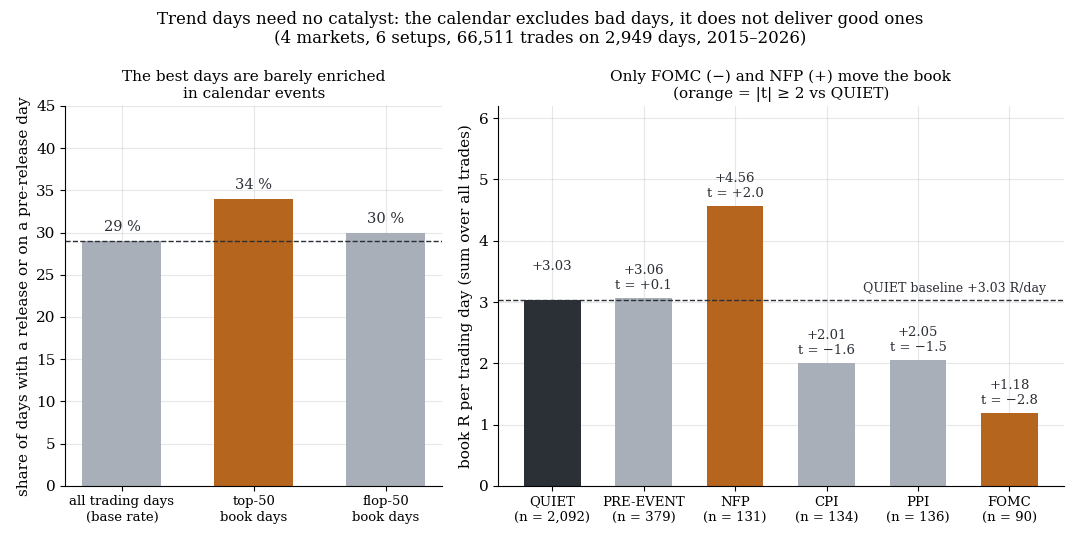
The best days are barely enriched in calendar events (34 % versus a 29 % base rate). Only FOMC downward and NFP upward move the book return significantly.
Every trading day gets exactly one class: the release itself (CPI, PPI, FOMC, NFP), PRE-EVENT (last trading day before a release, not itself a release), or QUIET. QUIET is the benchmark. Trend day: book day R ≥ +5 R; chop day: ≤ −5 R.
| Class | Days | R/day | t vs QUIET | P(trend ≥ +5 R) | P(chop ≤ −5 R) | Top decile |
|---|---|---|---|---|---|---|
| QUIET | 2,092 | +3.03 | — | 36.5% | 10.9% | 9.8% |
| PRE-EVENT | 379 | +3.06 | +0.1 | 35.9% | 11.1% | 10.3% |
| NFP | 131 | +4.56 | +2.0 | 41.2% | 9.9% | 16.8% |
| CPI | 134 | +2.01 | −1.6 | 27.6% | 16.4% | 9.7% |
| PPI | 136 | +2.05 | −1.5 | 26.5% | 11.8% | 8.1% |
| FOMC | 90 | +1.18 | −2.8 | 25.6% | 14.4% | 5.6% |
Significance convention: |t| ≥ 2. Two classes reach it, in opposite directions. FOMC days are dead for the book — a third of the return of quiet days, half as many trend days, top-decile rate almost halved. NFP is the only catalyst with a plus: +4.56 R/day and a top-decile rate of 16.8% against 9.8%. CPI and PPI sit in between — weaker than quiet days, but not reliably distinguishable; CPI days have the highest chop rate of any class at 16.4%.
3. Which session carries the effect?
Book day R mixes the EU and US sessions. Split apart, you can see where each class acts:
| Class | EU R/day | t | US R/day | t |
|---|---|---|---|---|
| QUIET | +1.84 | — | +1.19 | — |
| PRE-EVENT | +2.09 | +0.9 | +0.97 | −0.8 |
| NFP | +1.28 | −1.3 | +3.29 | +3.3 |
| CPI | +0.93 | −2.3 | +1.08 | −0.3 |
| PPI | +1.68 | −0.3 | +0.38 | −1.9 |
| FOMC | +1.28 | −1.1 | −0.10 | −2.9 |
Three findings with a mechanical explanation. FOMC hits the US session (−0.10 R/day, t = −2.9): the market waits until 20:00 Berlin, and the afternoon setups run into a market that does not want to move. CPI hits the EU session (+0.93, t = −2.3): the 14:30 Berlin release lands in the middle of the EU trading day and dismantles the range the morning setups are built on. NFP lifts the US session (+3.29, t = +3.3) — the only release whose reaction carries through into the afternoon setups.
4. The pre-event thesis dies
The August observation "waiting day = chop" does not generalise. PRE-EVENT days return +3.06 R against +3.03 on quiet days (t = +0.1), trend-day rate 35.9% against 36.5%, chop rate 11.1% against 10.9%. Across 379 pre-event days there is nothing to see. The waiting week before Jackson Hole was an anecdote.
5. The surprise proxy: the reaction at 14:30
What makes the calendar interesting is not the date but the surprise. We no longer have forecast data; as a substitute we take the market reaction itself: the absolute NQ move in the 15 minutes after the release (08:30–08:45 New York, 14:30–14:45 Berlin) on CPI, PPI and NFP days. This is lookahead-free because all our US setups trigger no earlier than 15:30 Berlin — the reaction is known at entry time.
| Reaction (median split, 400 event days) | n | US book R/day | SE | P(US chop ≤ −3 R) |
|---|---|---|---|---|
| LARGE (> 0.151%) | 200 | +2.07 | 0.34 | 13.5% |
| SMALL | 200 | +1.06 | 0.47 | 23.0% |
| QUIET baseline, US | 2,092 | +1.19 | 0.11 | 18.9% |
By quartile: Q1 +1.49, Q2 +0.63, Q3 +1.90, Q4 +2.24 R/day. The LARGE-vs-SMALL difference sits at t ≈ 1.7 — a tendency, not a hard finding. The dose series is not cleanly monotonic (Q1 is above Q2). What holds: a small reaction to a release is the worse environment — chop rate 23% against 13.5%, and worse than a day with no release at all.
6. What this means
The calendar is an exclusion tool, not a collection tool. Anyone waiting for event days to catch trend days is waiting for the wrong thing: 66% of the best days have no scheduled release. What the calendar reliably delivers is the opposite direction — FOMC afternoons and CPI mornings are measurably worse environments for our setup family.
This matches the regime finding in our volatility study: the conditions for trend days are state variables of the market (volatility, flow), not dates. Scheduled releases create volatility only when they surprise — and whether they do is visible in the reaction, not in the calendar.
What we take from this study as candidates is not "trade event days" but: throttle the US session on FOMC days, do not trust the EU range as a reference on CPI days, and read a mini-reaction at 14:45 as a warning sign for the US afternoon. All three are exclusions.
7. Limits
- In-sample across the full period, no walk-forward. The class cells with n = 90 to 136 days are small; the surprise proxy at t ≈ 1.7 is explicitly not significant.
- The calendar is incomplete. Only four US release types; ECB, BoE, earnings, geopolitics and unscheduled shocks (SNB 2015) belong to no class. Exactly such days form the top of the book — that is part of the finding, but also part of the gap.
- Surprise only as a proxy. Without forecast data we measure the reaction, not the deviation from consensus. Large reaction and large surprise are correlated, not identical.
- NFP rule without holiday shifts, FOMC dates only through April 2026 (data ending June 2026 is covered).
- Book day R mixes sessions and markets. Days are the unit, but DAX, FTSE, NQ and Dow on the same day are coupled; the t-values in section 2 are simple per-day t-values.
- The setup family is ours. Six setups; the midday group is missing. A different book could respond to event days differently.
📄 Full study as PDF: 7 pages incl. all tables, figures and limits (in German).
Disclaimer: Historical statistics are no guarantee of future market behaviour. This study is not investment advice. Trading involves risk of loss up to total loss.