Market mechanics, measured on minute data since 2015
What more than a decade of minute data says about the trading day.
This is what can actually be measured on the DAX, FTSE, Nasdaq and Dow: when opening breakouts carry and when they fail, where an index's upward drift really comes from, why a filter shines in the backtest and adds nothing in trading. 87 studies, including a fresh scan of about 897,000 logged tests, each with its data basis, method and limits, including the ideas that did not survive the test. Plus the instruments that produce these numbers.
Running study
This question is being measured right now. With you.
Hypotheses, design and analysis plan are fixed before the first answer. Data collection is open, and the result is published whatever it shows.
Running · questionnaire, about 10 minutes
In the move or beside it: does your own state change the re-entry?
Twelve real chart situations, each in one of four states: flat, in the move at +1.5 R, in the move at +5 R, stopped out at break-even. You decide whether you enter. Afterwards every decision is held against the real forward path.
Take part now →
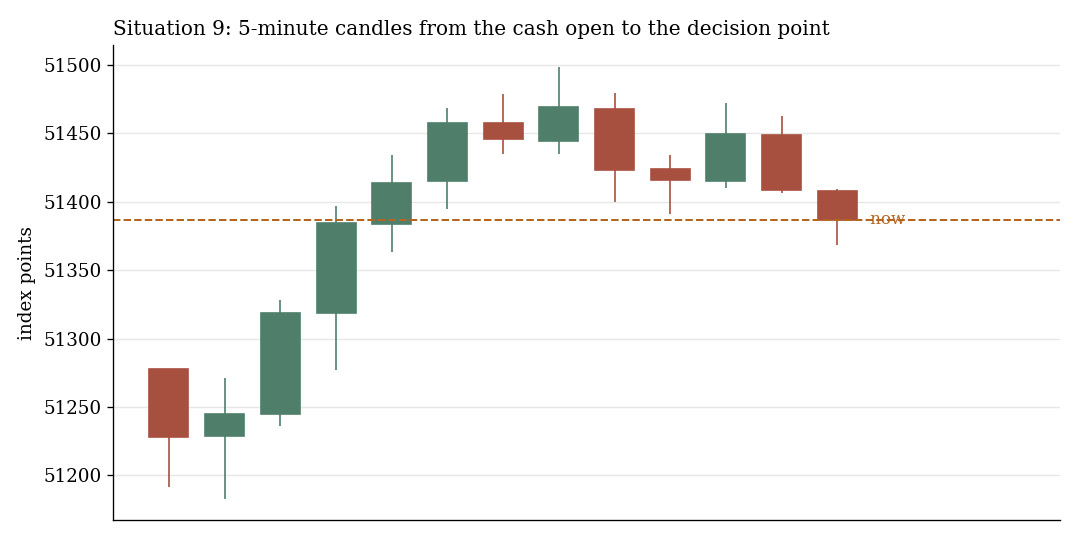
One of the twelve situations; market and date stay hidden. Pre-registration with hypotheses and analysis plan.
Start here
Three ways in, one data base.
Minute data since 2015, spread and slippage included, every number with its source.
Tools
Instruments in use
Three product families, each built on an openly documented measurement: risk utilities for MetaTrader 5, indicators on futures data for TradingView, standalone analysis applications.
MQL5 Market tools
MetaTrader 5 · one-time
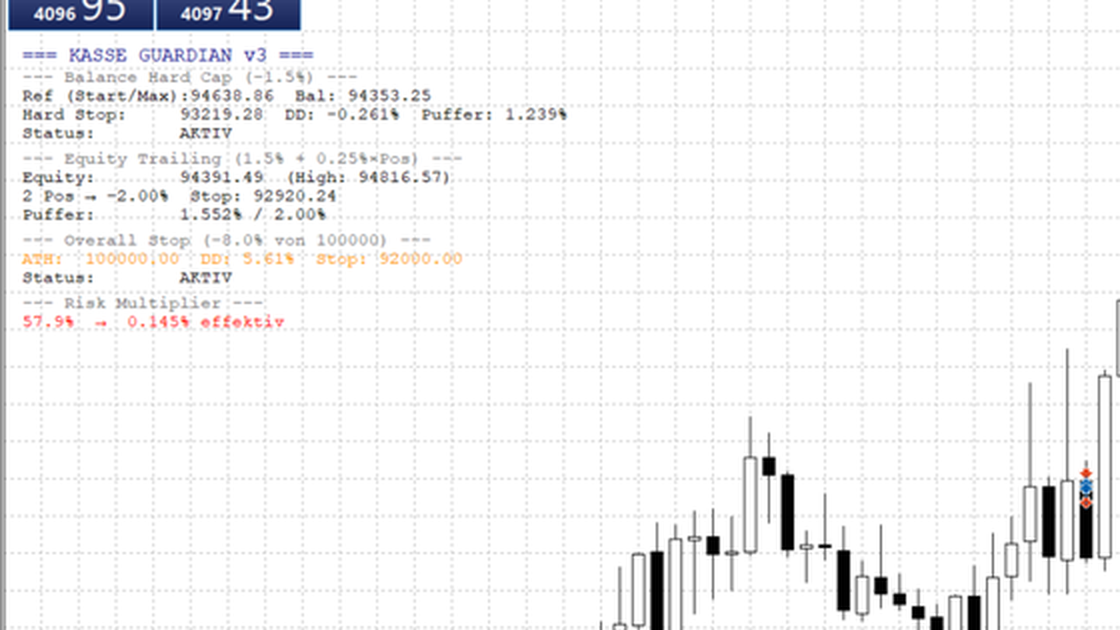
Risk utilities for live and prop accounts: enforce drawdown limits, mirror accounts — built from our own live operations.
Guardian live: hard cap, equity trailing, risk multiplier
TradingView instruments
10 indicators · open source
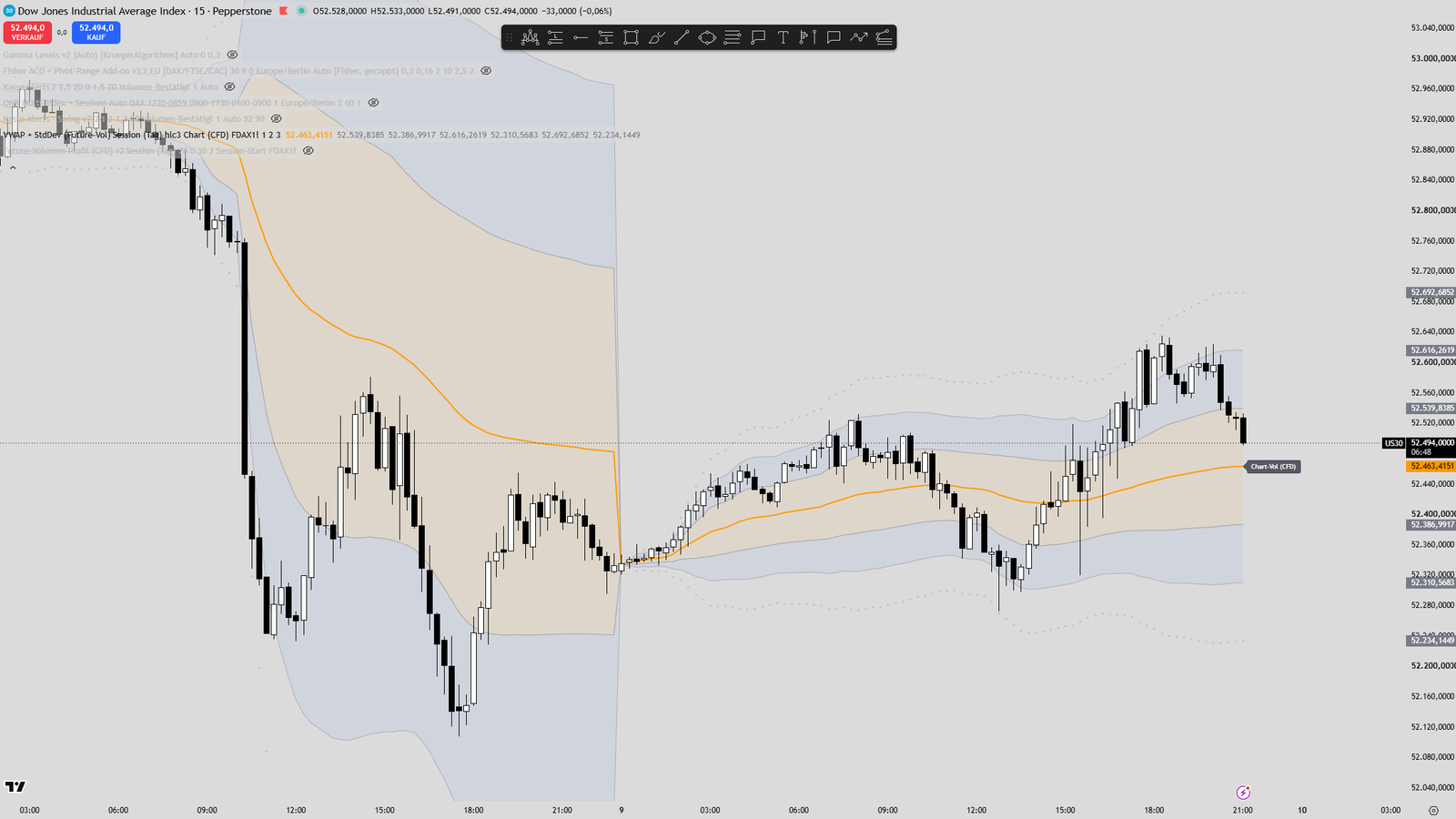
Real futures volume, dealer gamma and session structure right on your chart.
VWAP with σ bands from real futures volume, Dow M15
Custom Suites
Desktop & app · own applications
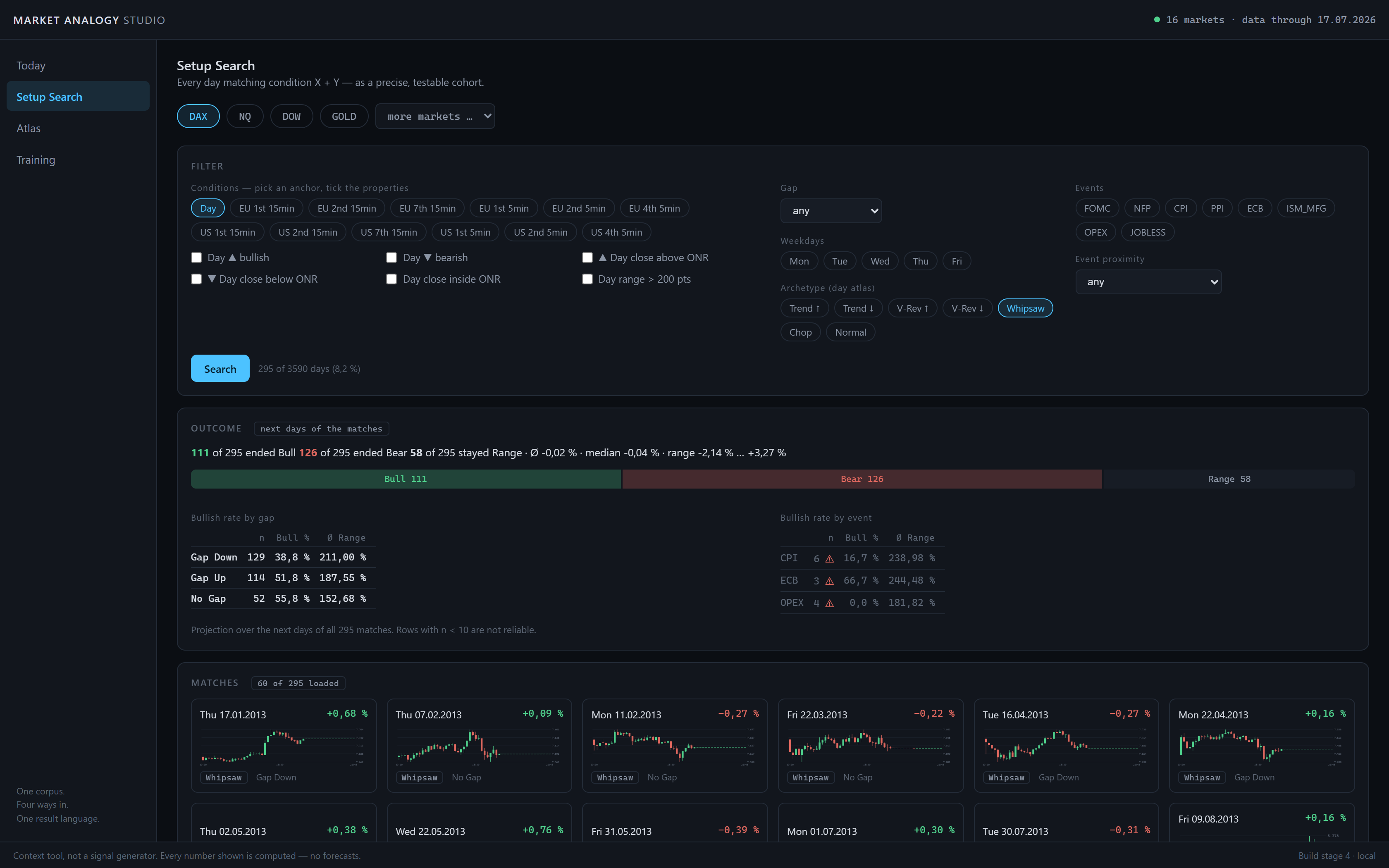
Standalone applications from daily operations: analog-day analysis (Studio), market context and alerts (MarketPulse) — and whatever comes next.
Studio: 295 of 3,590 days match the condition
Methodology
From hypothesis to running system
Five stages, documented on one continuous example: hypothesis, specification, in-sample measurement, validation gate, deployment.
- 01
Hypothesis
The starting point is an observation from our own trading: behaviour that seems to recur. Stated as a hypothesis about market, time window and condition, with no result yet and a clear null expectation.
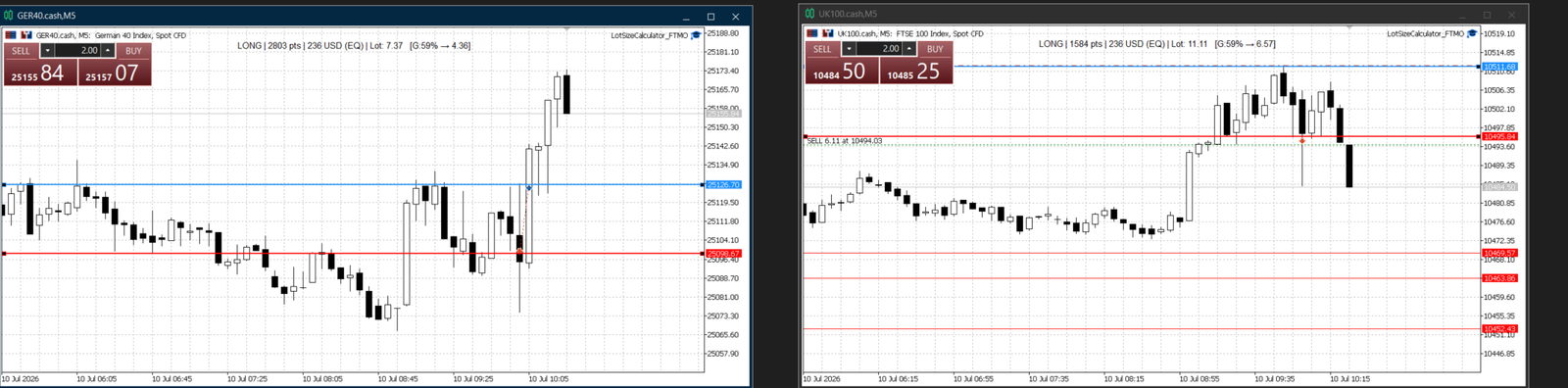
The desk where the observation happens: DAX and FTSE, same session, same setup. - 02
Specification & pre-measurement
Rule, market, period, exit and cost model are fixed before the first number exists. A pre-measurement against a benchmark (random walk, base rate) decides on the full test bench; most candidates end here.
Study: second candle on trend days →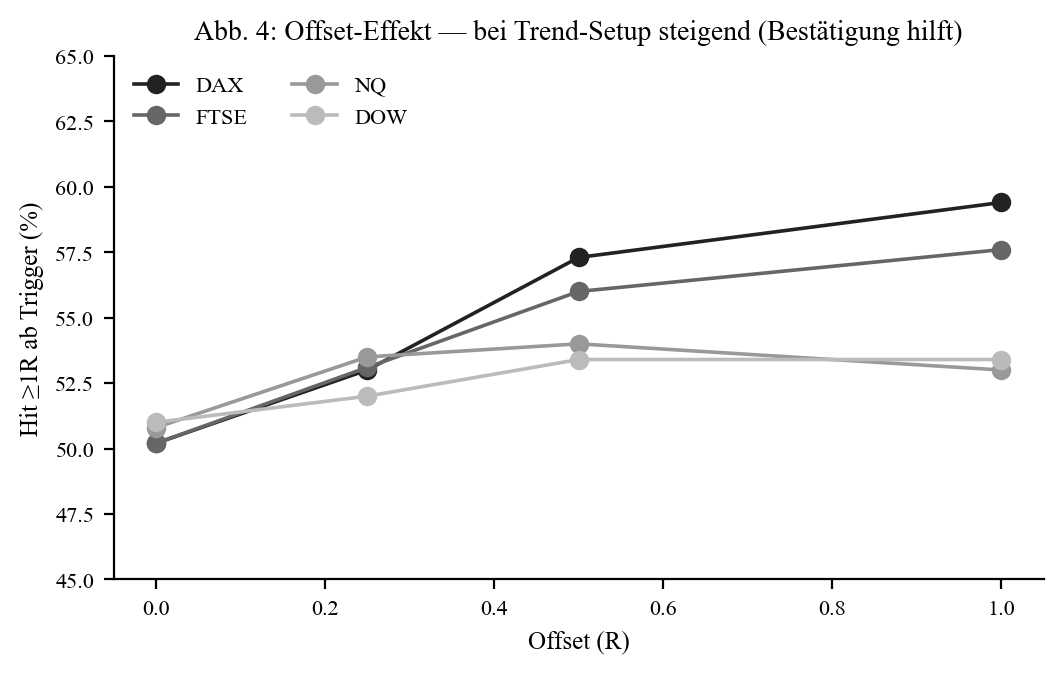
First evaluation: hit rate across the confirmation offset, four indices — confirmation helps, but not equally everywhere. - 03
In-sample measurement
The full history on minute data: episodes per market and setup, avgR with standard error and day-clustered t-statistic, spread and slippage at entry, regime decomposition by volatility and calendar.
Study: edge persistence →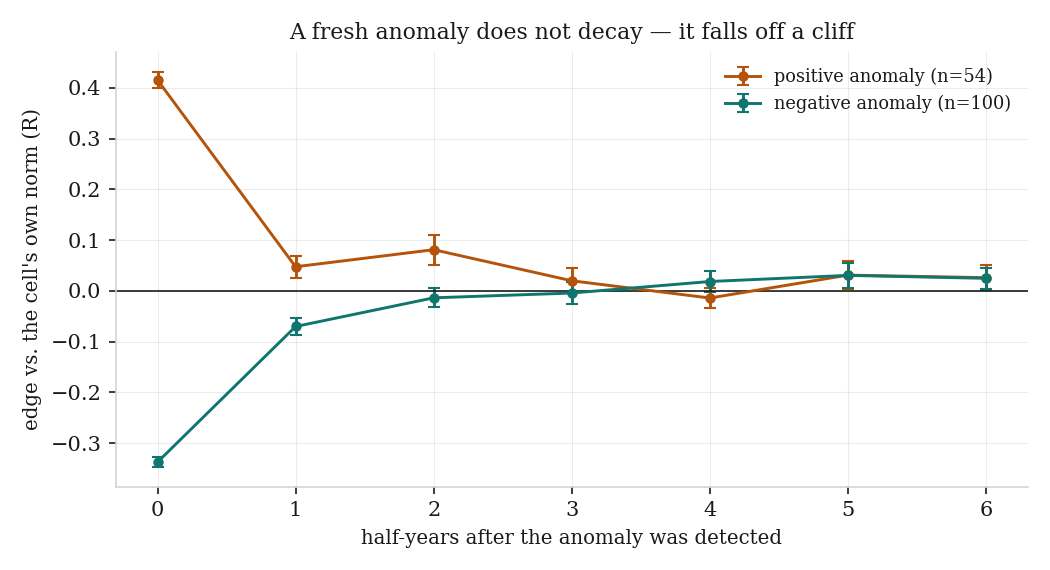
Measured, not assumed: a fresh anomaly does not decay slowly — it falls off a cliff after one half-year. - 04
Validation gate
Out-of-sample split, rolling walk-forward, Monte Carlo on the daily series, edge persistence across epochs. The gate separates a mechanism from a fit to the past; failed hypotheses are published with their numbers.
Study: validation gate →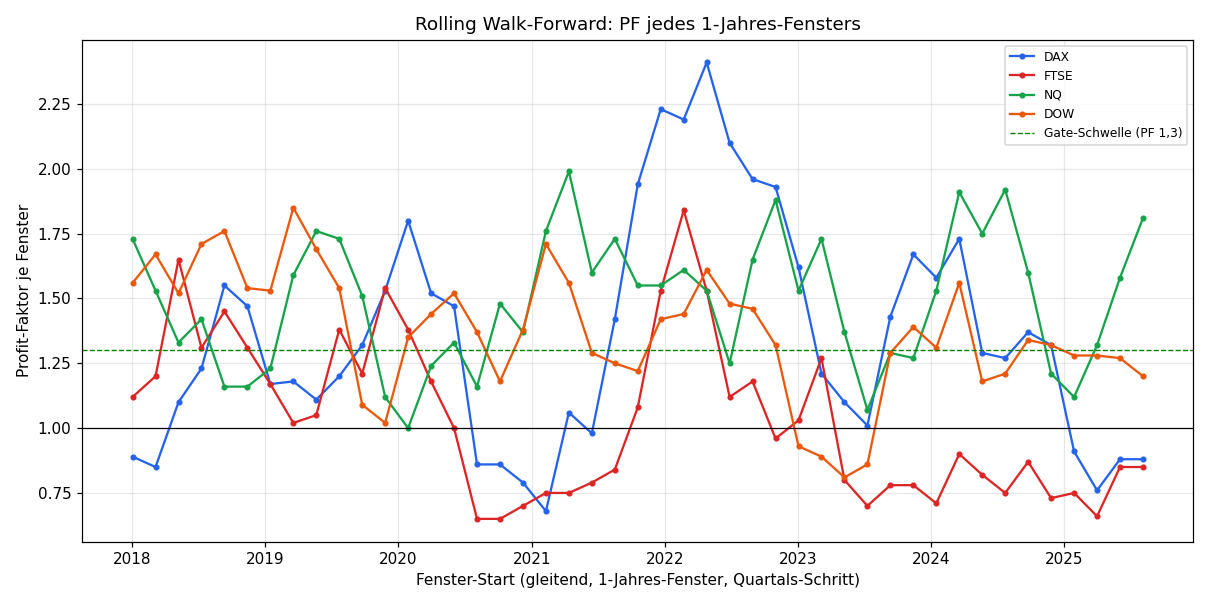
The gate in one picture: profit factor per rolling one-year window — no market stays above the threshold. - 05
Deployment
What passes the gate is implemented: as an open indicator on TradingView, as a utility on the MQL5 Market, or as an expert advisor with execution logic, risk limits and a reference backtest that is tracked in live operation.
Study: MT5 algo reference →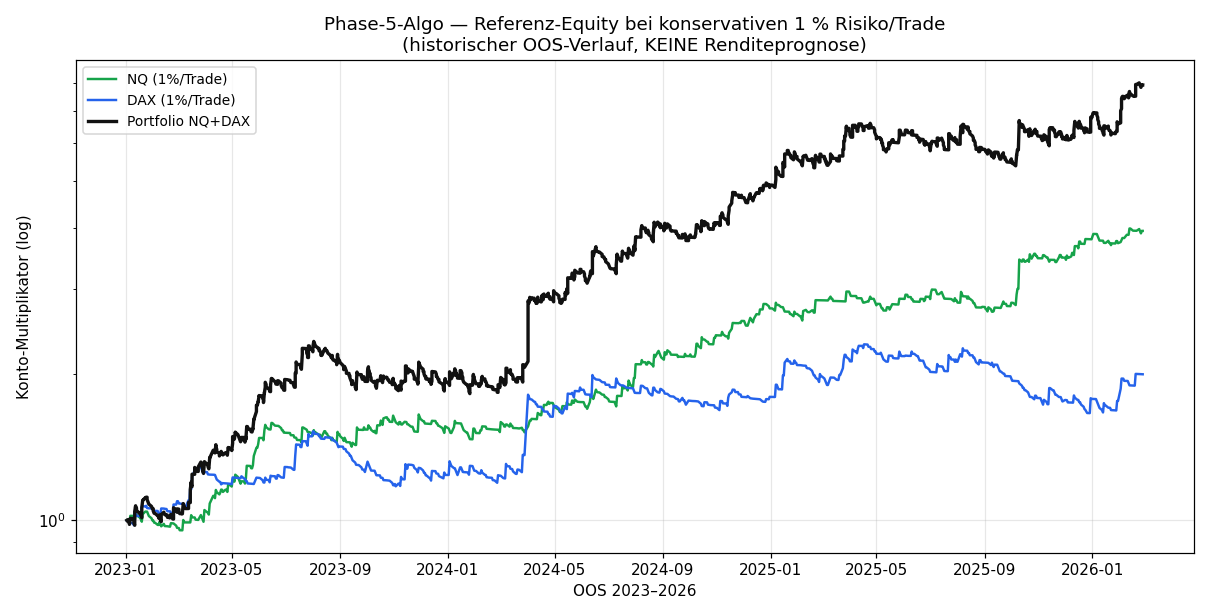
The finished EA in its reference backtest, out-of-sample 2023–2026 — a historical curve, not a return forecast.
Principles
Four rules behind every measurement here.
Before a number appears on this site, it has to pass four checks. Explained without formulas:

Chance is the ruler
Every rule also runs on a random market in which each candle is flipped by a coin toss. If it earns the same there, it is worth nothing.

Sealed until the test
The search runs on old data. The latest years stay sealed and are opened exactly once. Only what holds there counts.

Costs first
Many patterns are real but smaller than spread and fees. Every number here is net of costs, otherwise it misleads.

Count the ones you do not see
You remember the trades that worked. Here the failed ideas stand next to the confirmed ones, visible and filterable.
Research
A no is a result, too.
87 open studies, 8 of them with a confirmed edge and 51 without — each with its data basis, cost assumption and verdict. The failed ideas stand next to the confirmed ones; that is what makes the confirmed ones credible.
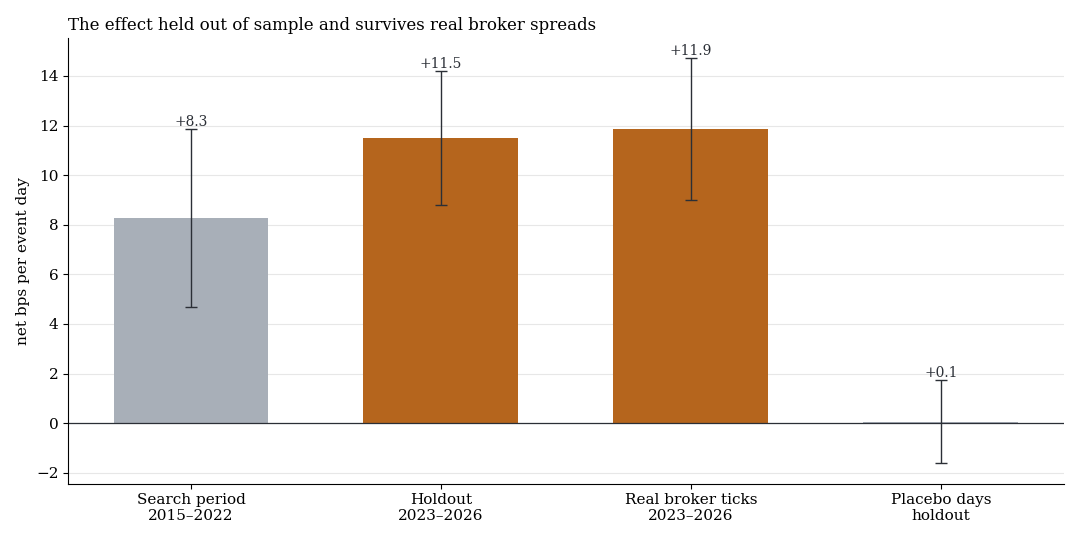
Edge confirmed
Index Event Days: the FTSE Falls Into the Auction Print, and It Held Out of Sample
Net per event day: the holdout sits above the search period, real broker ticks confirm it, placebo days sit at zero
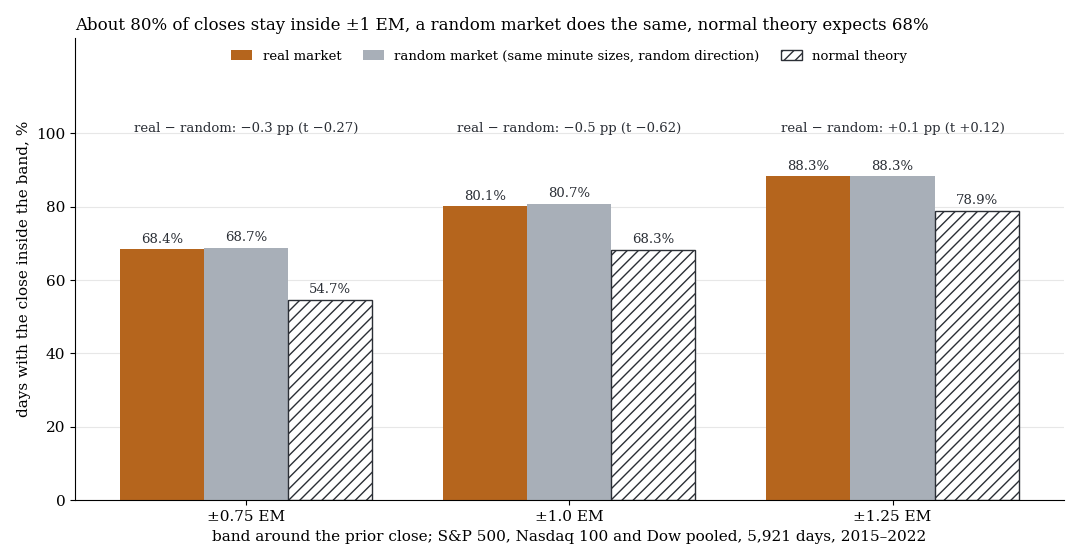
No edge
The Expected Move Holds 80% of the Time, but a Random Market Does Too, and Its Band Is Not a Range Boundary
About 80% of closes stay inside ±1 expected move, in the real market and in a random market alike, where the normal distribution expects 68%
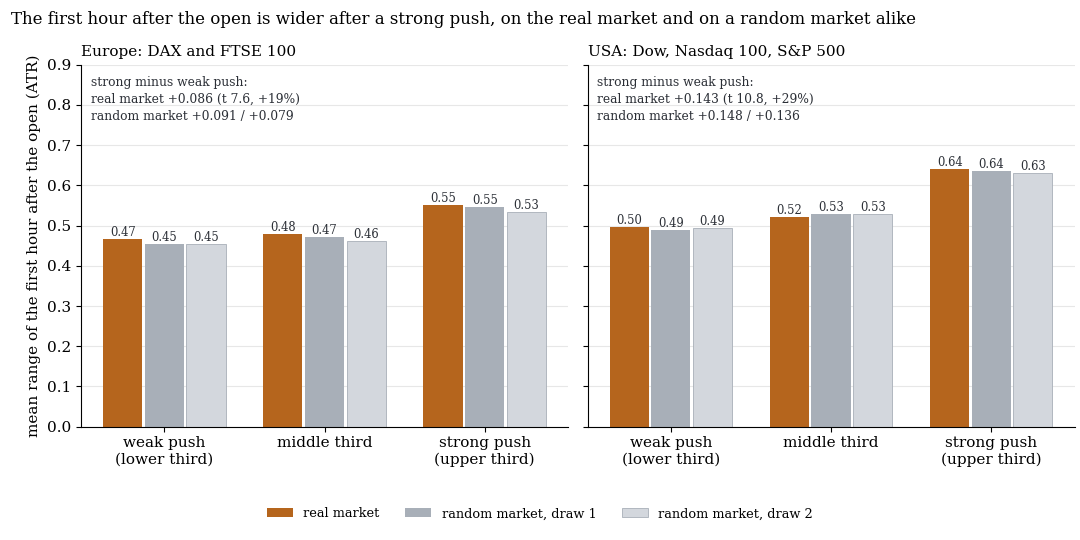
Measured
After a Strong Pre-Open Hour the Move After the Open Is Bigger, Not Smaller
After a strong push before the open the first hour is on average 19% (Europe) and 29% (USA) wider than after a weak one, and a random market shows the same
Platforms
One standard, five platforms.
Built natively instead of lowest common denominator — MQL5, Pine, C#, Python. NinjaTrader and the cTrader tools are in preparation.

The execution layer: runs unattended on live and prop accounts, with full access to orders, history and account state. MQL5 is close to C — fast but unforgiving: mistakes cost real money, which is why restart safety beats elegance.
Example: a drawdown guardian that enforces limits, or a recovery EA whose accounting nets out swap and commission.

The chart cockpit: Pine is deliberately limited — no file system, no external computation — which makes it fast to review and hard to obfuscate. Ideal for making context visible; unsuitable for heavy backtesting.
Example: projecting futures volume into CFD coordinates, or dealer-gamma levels as a chart overlay with alerts.

The research layer everything else stands on: data engineering, backtest pipelines, walk-forward and Monte Carlo. Anything is possible — which is why methodological discipline matters more than the language itself.
Example: the research pipeline behind our studies (minute data, 15 markets, a random market as the zero line), or a walk-forward test bench for your own rule.

Full execution control in a grown-up language: C# with a real type system, proper testing and direct API access to every order. The choice when order logic gets complex and has to stay traceable.
Example: fine-grained partial executions with complete logging of every fill.

The standard of the futures prop scene, technically C# family. In preparation — the risk utilities get ported first.
About
Background
KruegerAlgorithms grew out of our own trading: live in the markets for several years, research-driven from day one — because an idea is worth nothing until it has been quantified and tested. The systems here run by the same rules that get published.
What you see on this site is the part of the work that can be open: 87 studies on minute data since 2015, including a fresh scan of about 897,000 tests on 15 markets, 10 open instruments, 4 delivered projects — including the ideas that did not survive the test. You will not find signals here. Tools to measure for yourself — that you will.
- Every number names its source: market, period, sample, cost assumption.
- Negative results are published and filterable by verdict.
- The instruments are open — recomputable, not a black box.
- No return promises. No subscriptions.

"Really cleanly solved! Congratulations!"
Quant development for your own rule set.
Specification, backtest on minute data with a cost model, walk-forward validation and implementation as an expert advisor for MetaTrader 5. The first step is an assessment of whether the rule set can be automated cleanly and what the test bench already says about it; it is non-binding.