Data basis: Our own rule book of reference-candle breakouts (25 combinations of rule and market), here four rule families on DAX, FTSE 100, Dow and Nasdaq 100, corrected calculation chain on minute data, search period 2015–2022. The holdout from 2023 stayed untouched because no candidate met the criterion. Overnight range (ONR): high and low of the night before the cash session, valid on 73 % of trades. Benchmark: the difference to the rest of the same rule and market, and the same measurement on two random markets as a difference in differences. Pre-registered on 11 October 2026 before any number. No trading recommendation.
A concrete picture came from practice: one candle runs out of the overnight range, the next closes back inside, and then the breakout rule breaks in the opposite direction. The false breakout would have collected the stops on one side, and the real breakout then goes to the other. The second question: does it help if a double top or double bottom formed beforehand?
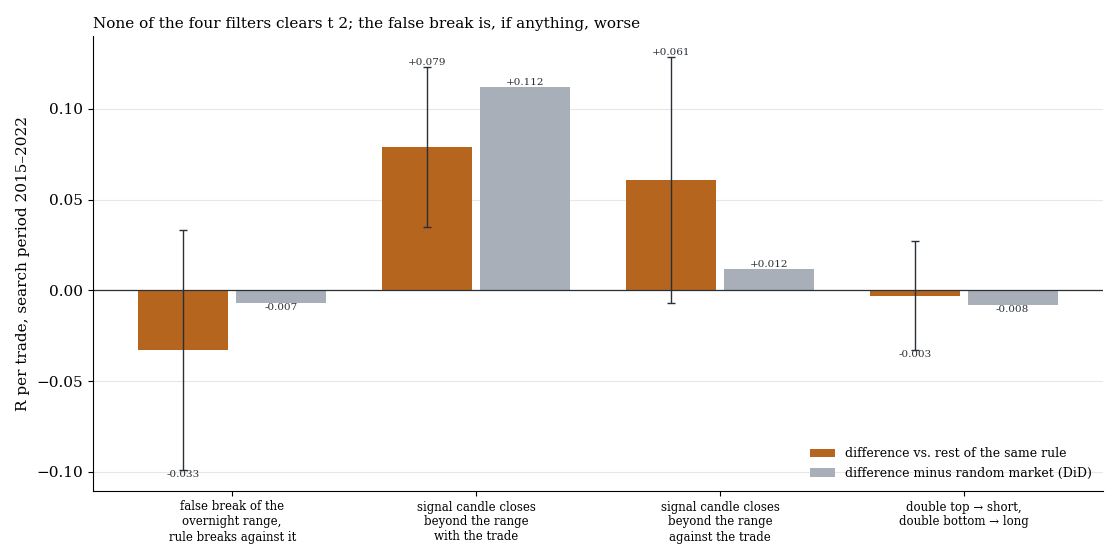
Difference in R per trade against the other trades of the same rule and market, with one standard error (orange), and the same difference minus the random market (grey).
1. Four primary tests
| Test | n group | R group | R rest | Δ (t) | Difference in differences (t) | q |
|---|---|---|---|---|---|---|
| False breakout of the ONR, rule breaks against it | 1,350 | −0.046 | −0.017 | −0.033 (−0.5) | −0.007 (−0.1) | 0.86 |
| Signal candle closes beyond the ONR in the trade's direction | 3,531 | +0.025 | −0.044 | +0.079 (1.8) | +0.112 (2.0) | 0.31 |
| Signal candle closes beyond the ONR against the trade's direction | 1,500 | +0.008 | −0.044 | +0.061 (0.9) | +0.012 (0.1) | 0.72 |
| Double top → short, double bottom → long | 3,391 | −0.048 | −0.042 | −0.003 (−0.1) | −0.008 (−0.2) | 0.95 |
Search period 2015–2022, R per trade after costs. Δ within the same rule, market and direction, cluster standard errors by date, multiple-testing correction over four tests.
Neither the false breakout nor a prior double pattern makes the rules better. The only contrast with direction is the second one: when the rule breaks while the price already stands beyond the ONR in the trade's direction, it sits +0.079 R above the rest. That is a with-the-trend effect with t 1.8; it misses the criterion (t ≥ 2) and lifts the best group only to +0.025 R. It is also carried by the US markets alone, Europe sits at +0.006.
2. Side findings
The tight variant of the false breakout (the candle right before the signal candle outside, the signal candle back inside) is, if anything, worse: Δ −0.082 R (t −1.2), for shorts −0.184 R (t −1.8). The literal case from practice, one particular rule short after exactly this pattern, occurred only 37 times in eight years. Its mean of +0.226 R against +0.179 R has a standard error of 0.54 R, so it is neither confirmed nor refuted, just not measurable. Trades against a fresh double pattern (long after a double top, short after a double bottom) ran worse (difference in differences −0.121 R, t −2.3), but this was not registered as a primary test and is only a hint. Of 130 calculated rows, 11 have an absolute t above 2, while about 6.5 would be expected by chance, with mixed signs.
What this means
False breakouts of the overnight range and double patterns are ineffective as filters for breakout rules. This joins our measurements of Smart Money Concepts and of the overnight range and the prior close.
Limits
- Minute chain, no ticks. The ONR is missing on 27 % of trades, mostly in early years without night prices.
- One double-pattern definition (local extremes within ±3 candles, tolerance 0.10 ATR, active within the last two hours).
- Only four rule families of the book; other rules and markets such as gold or currencies are not tested.
- Holdout not run, because no candidate met the criterion.
All pattern families and holdouts in the overview.
📄 Full study as PDF: 6 pages incl. all tables, figures and limits (in German).
Disclaimer: Historical statistics are no guarantee of future market behaviour. This study is not investment advice. Trading carries a risk of loss up to total loss.