Data basis: S&P 500, Nasdaq 100 and Dow as CFDs, Dukascopy minute data on New York time, search period 2015–2022. Costs per round trip in the cash session as in every study of this series, 2.5 times that outside the cash session, plus 2 bps swap per calendar night. Benchmarks: placebo days with the same weekday, other days, always long, two random markets. Cluster t by date, multiple-testing correction over twelve cells. Pre-registered on 30 October 2026 (SHA-256 eda699ba…). The addendum on the 02:00 to 06:00 Berlin window from 9 November 2026 is descriptive and also covers the DAX and 2023–2026. No trading recommendation.
Research knows several calendar effects that are said to work mainly at night: the rise before rate decisions of the US Federal Reserve, gains on days with major macro data, and a recovery when the VIX curve inverts. Our earlier overnight study had shown that the ordinary overnight return lies below CFD costs. The question here was whether the event nights concentrate enough return to beat the costs.
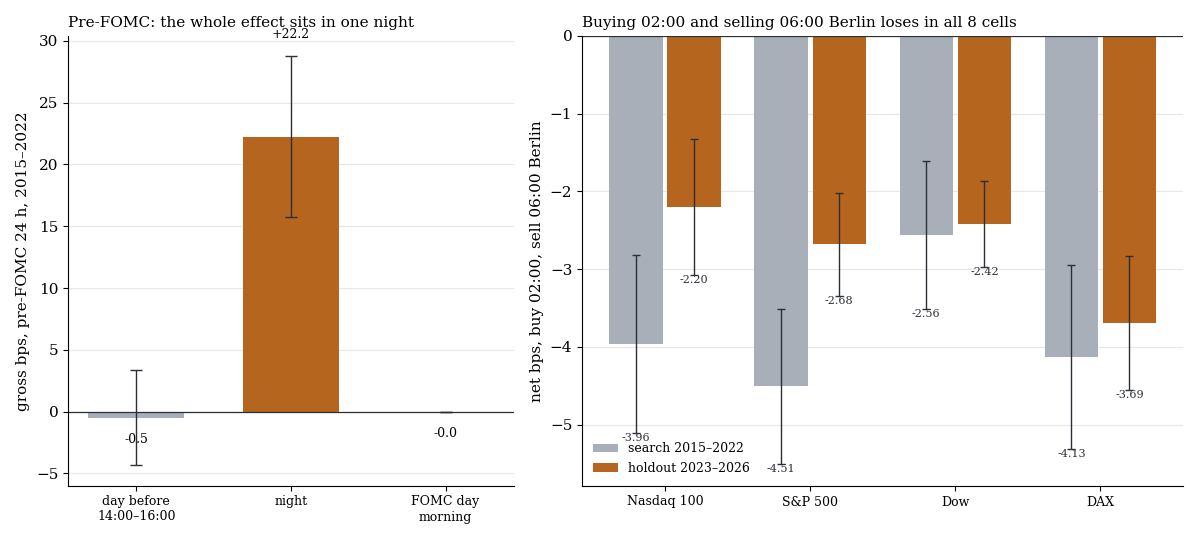
Left the pre-FOMC long, gross, broken down into the afternoon before, the night and the morning of the decision day. Right buying at 02:00 and selling at 06:00 Berlin, net per market, search period grey, holdout orange, with one standard error.
1. Three rules
| Family | Rule |
|---|---|
| A Pre-FOMC (primary) | long from 14:00 New York the day before to 13:55 on the day of the rate decision |
| B Announcement day | long from the prior close to the close of the day with NFP, CPI, PPI or FOMC |
| C VIX curve inverted | VIX above VIX3M at the prior close, long 09:31 to 15:59 |
2. Result
| Family | n | net bps | t | Benchmark | Random market 1 / 2 | q |
|---|---|---|---|---|---|---|
| A Pre-FOMC | 189 | +17.02 | 2.07 | placebo −1.76 (Welch 3.23) | +1.87 / +7.08 | 0.19 |
| B Announcement day | 1,010 | −2.72 | −0.39 | other days −0.80 | +3.35 / −2.73 | 0.76 |
| C VIX above VIX3M | 505 | +8.28 | 0.64 | always long −1.36 | +15.21 / −9.67 | 0.75 |
Search period 2015–2022, net after costs and swap. n counts market days (63 rate decisions times three markets in A).
The pre-FOMC effect is real, but it is not a steady drift. Broken down, the afternoon before gives −0.50 bps and the morning −0.02 bps, while the night gives +22.23 bps gross (t 3.41). Only four of eight years are positive: 2022 brings +91 bps, 2020 +51 bps, 2021 −21 bps. A few big nights carry the mean. After the multiple-testing correction q is 0.19, the gate (q ≤ 0.10) is missed. No holdout was run.
Announcement days including the night are zero; within the classes it ranges from PPI −21.27 to FOMC +16.01 bps, none above |t| 1.4. An inverted VIX curve brings +8.28 bps, a random market with the same rule +15.21. Across VIX terciles the effect is flat.
3. Addendum: 02:00 to 06:00 Berlin
From practice came the impression that the overnight drift mostly happens between 2 and 6 a.m. German time. Buy at 02:00, sell at 06:00:
| Market | Search period gross (t) | net (t) | Holdout 2023–2026 gross (t) | net (t) |
|---|---|---|---|---|
| Nasdaq 100 | +1.94 (1.69) | −3.96 (−3.46) | +0.98 (1.12) | −2.20 (−2.51) |
| S&P 500 | +1.57 (1.56) | −4.51 (−4.50) | +0.92 (1.38) | −2.68 (−4.04) |
| Dow | +1.02 (1.07) | −2.56 (−2.69) | +0.03 (0.06) | −2.42 (−4.36) |
| DAX | +0.69 (0.58) | −4.13 (−3.48) | −0.39 (−0.45) | −3.69 (−4.28) |
bps per night, 1,238 to 1,287 nights in the search period, 877 to 882 in the holdout.
In the search period the drift sat later: the window 05:00 to 09:00 brought +3.6 bps (t 2.9) in the Nasdaq 100 and +4.5 bps (t 3.1) in the DAX, carried by the hours 05 and 08. In the holdout nothing of it is left (Nasdaq 100 +0.4, DAX +1.0 bps gross). Thursday stood out as weak in the search period at around −5 bps and is positive in three of four markets in the holdout, so it is noise.
What this means
The overnight return exists, but it is either spread thinly and therefore smaller than swap and night spread, or it sits in a few event nights that cannot be told apart from the rest in advance. With that, the freely testable calendar effects from the literature are done for us. Related: Macro events intraday and Time of day and calendar intraday.
Limits
- Few events. 63 rate decisions in eight years, and the three markets are highly correlated.
- Cost model. Swap of 2 bps per night and the night spread as a multiple of cash costs are assumptions close to a retail CFD broker. With futures the costs would look different.
- No surprise direction. Actual against forecast was not available for the search period, only the calendar is tested.
- Holdout only in the addendum. For A to C, 2023–2026 stayed untouched because the gate was missed.
All pattern families and holdouts in the overview.
📄 Full study as PDF: 5 pages incl. all tables, figures and limits (in German).
Disclaimer: Historical statistics are no guarantee of future market behaviour. This study is not investment advice. Trading carries a risk of loss up to total loss.