Data basis: SEC Insider Transactions Data Sets 2006 to Q3 2026 (freely available, there are none before 2006), purchases with transaction code P, S&P 500 universe as of each date, adjusted daily prices. Entry at the open after the filing date. Search period 2006–2018, holdout 2019 to 16 October 2026, exactly one run. Costs of a stock CFD hedged against SPY, as in our single-stock study. Benchmark: on average 28 to 34 control stocks per purchase from the same return and volatility bucket on the same day, placebo with the date shifted by 120 trading days. Pre-registered on 4 November 2026 (SHA-256 4f0e3c57…, amendment on symbol mapping 4d1d75fb… before the holdout). No trading recommendation.
The literature on insider purchases is old and clear: when officers buy with their own money, the stocks do better than the market afterwards, for weeks and months. The filings are public and free. The question was whether anything of it is left in the S&P 500 today and whether it carries after the costs a private trader pays with CFDs.
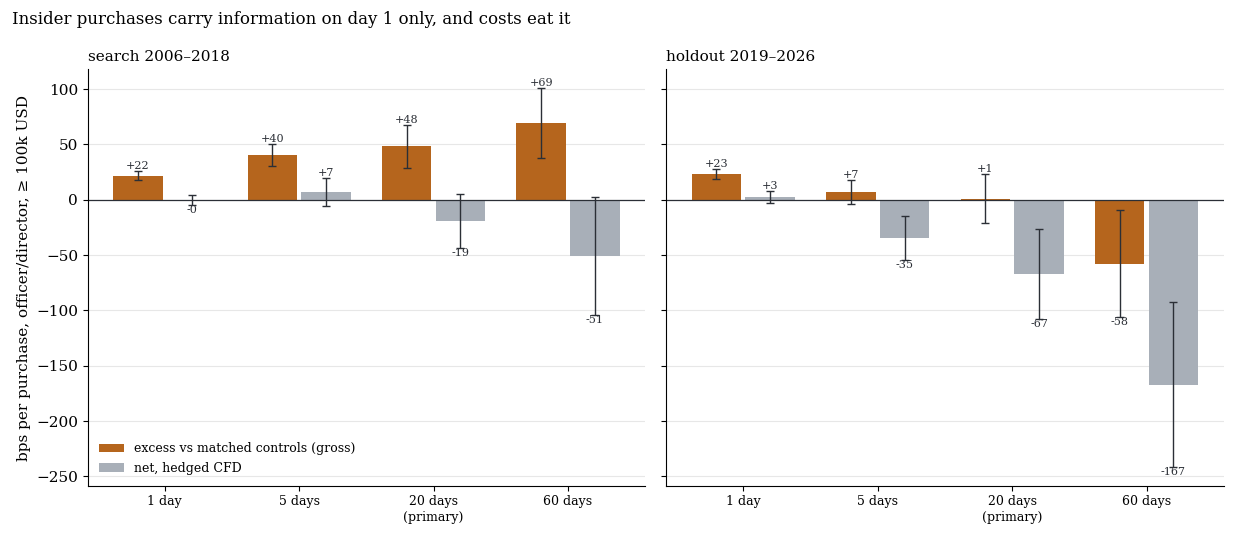
Officers and directors, purchases of 100,000 USD or more. Orange the excess over the control stocks before costs, grey net as a CFD hedged against SPY, each with one standard error. Left search period, right holdout.
1. The rule
Four variants: all purchases (V1), officers and directors only (V2), the same from 100,000 USD (V3) and clusters of at least three insiders (V4). Holding periods of 1, 5, 20 and 60 trading days. Primary: V3 with 20 days. Two gates kept apart: net (tradable as a CFD) and gross against the controls (is there information?).
2. Result
| V3, holding period | Search period excess bps (t) | net bps (t) | Holdout excess bps (t) | net bps (t) |
|---|---|---|---|---|
| 1 day | +21.9 (5.54) | −0.2 (−0.05) | +23.0 (5.03) | +2.5 (0.45) |
| 5 days | +40.2 (3.98) | +6.9 (0.55) | +7.3 (0.68) | −34.8 (−1.76) |
| 20 days (primary) | +48.4 (2.48) | −19.2 (−0.78) | +1.1 (0.05) | −67.4 (−1.66) |
| 60 days | +69.3 (2.20) | −50.6 (−0.95) | −57.6 (−1.20) | −167.1 (−2.25) |
Search period 2,303 to 2,312 purchases, holdout 1,539 to 1,580 purchases.
Net, none of the 16 cells passes the gate, neither in the search period nor in the holdout. Gross, ten cells passed in the search period. In the holdout only the first day is confirmed, in all three variants V1 to V3 (q 0.000). The multi-day drift from the literature has disappeared from the S&P 500 in 2019 to 2026: after 20 days the excess is +1.1 bps.
Two findings explain why the control group is needed. Insiders buy after declines: the stock's 20-day return at the purchase has a median of −3.2 % (search period) and −3.8 % (holdout), against +0.8 % for all stocks on the same day. And part of the move has already happened before the entry: from the close before the filing to the open after it, the stock rises against SPY by a mean of 39.2 bps (search period) and 65.4 bps (holdout). The placebo check with shifted dates gives about zero for 1 and 5 days (|t| ≤ 0.61), so the controls do not inflate the result.
What this means
Insider purchases contain information, but it is fast. On the first day it is around 23 bps over comparable stocks, and the costs of a hedged stock CFD eat almost all of it. A tracker for insider purchases is therefore not a trading signal for CFD traders, at most a piece of information. Related: S&P 500 additions and RSI(2) on S&P 500 stocks.
Limits
- Survivorship remainder. In the search period 355 of 2,779 V3 purchases were rejected (13 %), another 112 had no price series; renamed tickers are partly missing.
- Idealised entry. Open after the filing date, although in a sample of 118 filings 58 % arrived before 16:00 and one could have traded earlier. An entry right after the filing cannot be tested with these data.
- S&P 500 only. Small caps, on which the literature rests, are mostly not tradable as CFDs and are not tested here. With real shares and lower costs the first day might be enough gross.
- Own mistake, disclosed: the first search run partly mismatched symbols. This was corrected by an amendment before the holdout; the verdict stayed the same.
All pattern families and holdouts in the overview.
📄 Full study as PDF: 6 pages incl. all tables, figures and limits (in German).
Disclaimer: Historical statistics are no guarantee of future market behaviour. This study is not investment advice. Trading carries a risk of loss up to total loss.