PropStockDip
Buys short pullbacks in S&P 500 stocks, one chart for the whole list.
PropStockDip checks about 500 S&P 500 stocks once a day, shortly before the US close, buys the ones that had a sharp short pullback inside a long term uptrend, and sells them at the first recovery or after about two weeks at the latest. I measured the rule with share CFD costs on 2005 to 2018 and tested it once on 2019 to 2026. It passed there locally, but not the global correction for multiple testing. The return is small, it swings a lot from year to year, and the drawdowns are real, and that comes first here. PropStockDip is a small add-on for traders who trade single US stocks as CFDs, not a main strategy. Without US share CFDs at your broker it does nothing for you.
Standalone EA: PropStockDip opens positions on its own and usually holds them overnight, often over a weekend. If your account does not allow weekend holding, it does not fit.
49.99 USD one-time
No subscription. 10 activations. Purchase, licence and invoice run through the MQL5 Market.
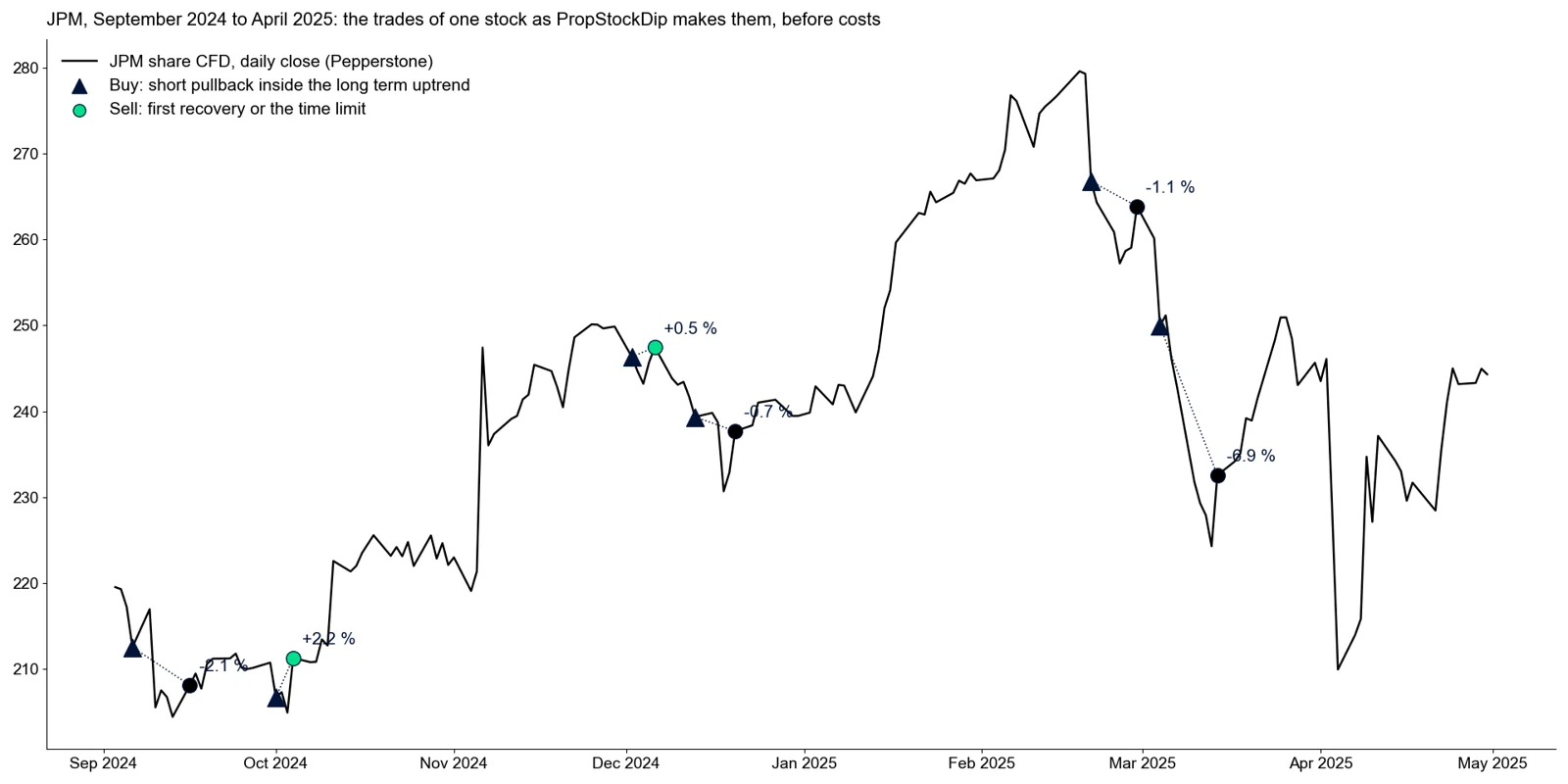
What it looks like on the chart
One stock of the list
JPM from September 2024 to April 2025 on Pepperstone data, the way PropStockDip makes the trades, before costs. I fixed the period before looking at the trades: two of six trades win, one loses 6.9 percent in the March 2025 sell off. Both belong to the rule.
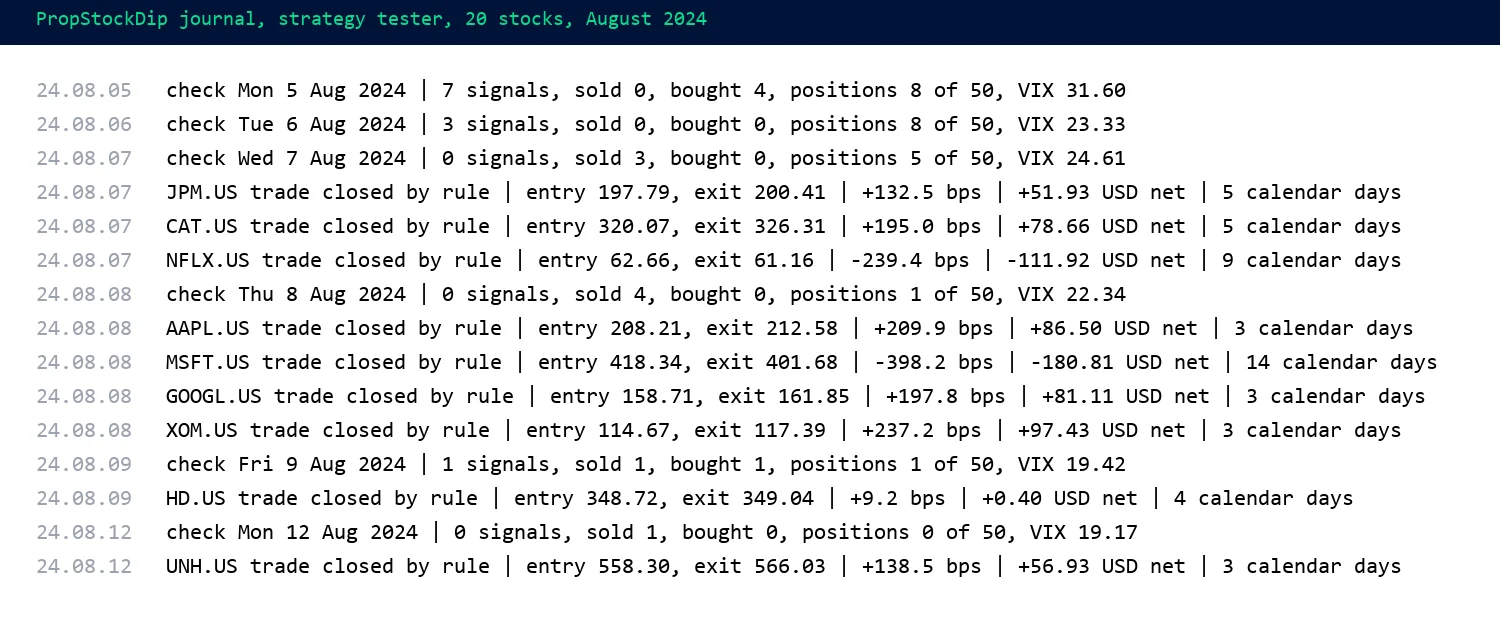
Journal in the strategy tester
Real lines from the MetaTrader strategy tester on Pepperstone data, 20 stocks, August 2024: every daily check with signals, buys and sells, every closed trade with its result in basis points and in money after commission and swap.
What it does differently
One chart, many stocks
The S&P 500 list is built in (August 2026). PropStockDip finds the symbol names itself (AAPL.US, AAPL, #AAPL and similar), or you set your broker’s prefix and suffix. Your own ticker list works too.
Nothing to optimise
Entry, exit and trend values are fixed in the code, the same values as in the study. You set the number and size of the positions and the spread limit.
Checked against the research
The EA logic, rebuilt in Python, produces the same trades on the Pepperstone daily prices of 29 stocks from 2020 to 2026 as my research calculation: 1,180 of 1,190, the differences are two spin offs and the end of the window. In the MetaTrader strategy tester the EA makes the same trades on 20 stocks from 2021 to 2024 as this Python calculation, 558 of 563.
Optional controls, not validated
In my data the rule did better at high VIX and on volatile stocks. I found that only after the holdout, on the same data, so it is a hypothesis. VIX control and volatility preference are therefore off by default. I wrote down a forward test on a demo account before it starts and will report the result, also if it is negative.
Test results
The research the rule comes from: S&P 500 members on each day, 2005 to October 2026, costs as at my broker (0.02 USD commission per share and side, overnight financing, spread).
Per trade: search period, holdout, real CFD closes
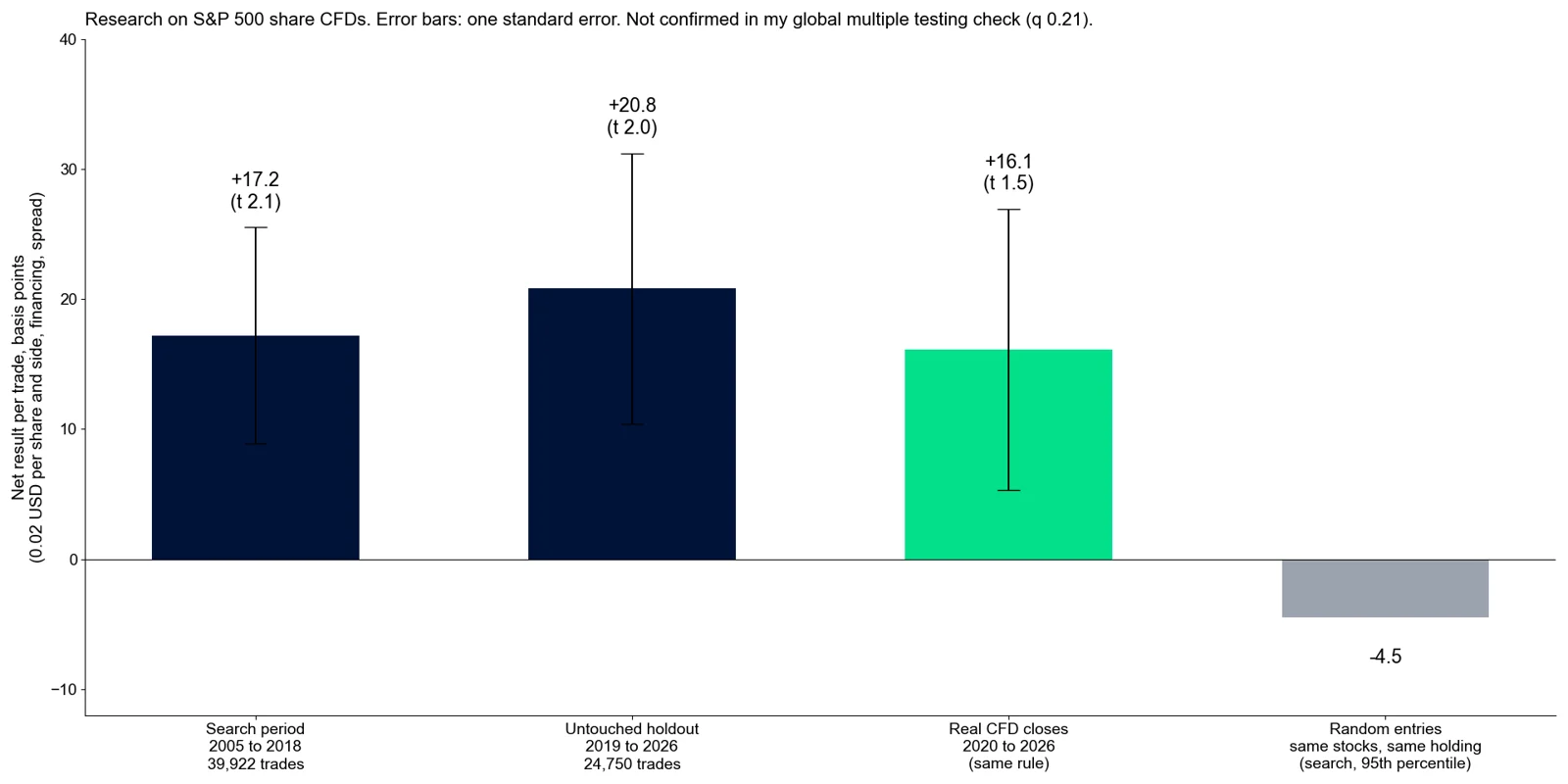
- 2005 to 2018
- 39,922 trades, +17.2 basis points per trade (t 2.1)
- Holdout 2019 to 2026
- 24,750 trades, +20.8 basis points per trade (t 2.0)
- Real CFD closes 2020 to 2026
- +16.1 basis points per trade (t 1.5)
- Global multiple testing correction
- q 0.21, not passed
The effect is broad: every one of the 24 neighbouring settings I checked was positive. Statistically it stays weak. The years vary a lot, 2022 was clearly negative.
As a portfolio: 10 stocks, no leverage
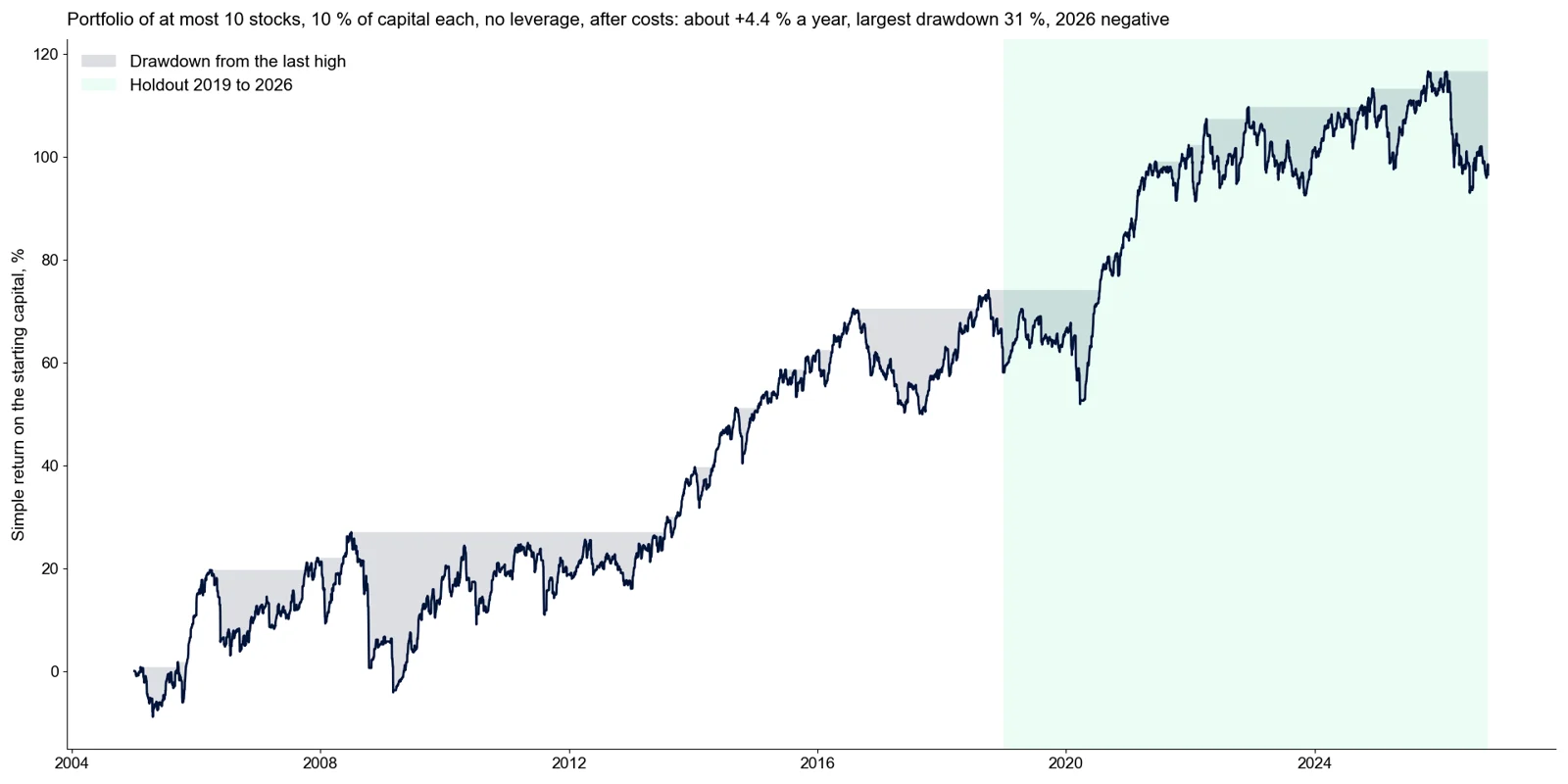
- Setup
- at most 10 positions of 10 % of capital each
- Return
- about +4.4 % a year, simple return
- Largest drawdown
- about 31 % of the starting capital (2008 to 2009)
- Best year
- +22 % (2013)
- Flat stretches
- 2010 to 2012 and 2016 to 2018 around zero, 2008 about minus 16 %
- Sharpe ratio
- about 0.4
- 2026 to mid October
- about minus 16 %, the weakest year in the test
This is not a fast growth EA. On prop accounts with loss limits it needs a third of the default size or less.
- A backtest is not a promise. Past results do not guarantee future ones.
- The stock list is today’s; delisted stocks are missing from the real CFD closes (survivorship).
- On crash days many stocks signal at once, and the slots fill with one bet on the rebound.
What it does not do
- No stop loss: the tested rule has none. Risk comes from the position value and the number of positions.
- Small returns, drawdowns up to 31 % in the backtest, 2026 about minus 16 % so far.
- Thin margin per trade (about 0.2 % after costs): at 0.15 % spread per round trip it falls to +8.6 basis points and is no longer significant. Check your broker’s spreads first.
- About two thirds of the trades run over a weekend.
What you need
- MetaTrader 5, hedging or netting account
- US share CFDs at your broker
- An account that allows weekend holding
- Terminal or VPS running before the US close
PropStockDip · 49.99 USD one-time
No subscription. 10 activations. Purchase, licence and invoice run through the MQL5 Market.
You have your own strategy and want it as an EA? I build it for you, tested on real ticks, with full source code.
From the same family
- PropGuardian ↗ · 79 USDCloses your positions before the prop firm closes your account.
- PropMirror ↗ · 59 USDOne trade on the master, the same position on each of your accounts.
- ForcedFlow · 499 USDTrades flows in which someone has to buy or sell at a fixed time.
- PropDip · 99 USDBuys short dips in the US indices, with a rule that was measured before it was built.
- PropSizer ↗ · freeDrag two lines, read the right lot size.
- PropCorrelation ↗ · freeShows whether your open positions are really one single bet.